Relocation housing budget: what to plan for in Oxfordshire
A line-by-line relocation housing budget for one employee in Oxfordshire: advertised rents, what each home type’s rent includes and omits, deposits and short stays.
Published7 min read
On this page
Finance has asked for a housing number for the new Oxfordshire hires, and the answer isn’t one number. It depends on the home type, how long the person stays, what the rent covers and which costs fall to the employee. A figure that leaves those out tends to be wrong by the time the first invoice arrives.
This post builds a relocation housing budget line by line, using B-Hive Living’s advertised rents and terms, with a simple one-employee comparison of a 3-month and a 12-month stay. It also covers what the rent leaves out and what to ask for in a quote.
What goes into a relocation housing budget?
Start with the monthly rent for the home type and the length of stay. Then add what the rent leaves out, the deposit or its alternative, and any short-stay premium. Tax treatment sits outside the housing numbers and needs your payroll adviser.
A workable budget for one employee has these lines: rent, council tax if the rent excludes it, TV licence if it does, parking if they have a car, deposit or deposit fee, and the premium for a short stay. For a team, multiply by headcount, but check the home types first, because a team of five in studios is a different figure from five en-suite rooms.
B-Hive says its rates for mid to long stays are agreed in advance rather than moving with demand and season, as hotel and Airbnb prices do. That helps a budget, because the rate you agree for your dates is the rate you plan with. If you are comparing against a hotel, price the same dates for both and add every line from the list above to the home. Our relocation housing policy template is a useful place to record the answer.
What do B-Hive’s advertised rents look like over 3 and 12 months?
B-Hive advertises co-living en-suite rooms from £995 a month, studios from £1,400 and one-bed flats from £1,500. Those are the prices for stays over 6 months. Studios and one-bed flats are in Bicester only. Co-living en-suite rooms are in Bicester and Kidlington.
| Home type | Advertised from, per month | 3 months at the advertised rate (comparison only, not a 3-month price) | 12 months at the advertised rate |
|---|---|---|---|
| One-bed flat | £1,500 | £4,500 | £18,000 |
| Studio | £1,400 | £4,200 | £16,800 |
| Co-living en-suite room | £995 | £2,985 | £11,940 |
The table is plain arithmetic: each figure is the advertised monthly price multiplied by the number of months. It leaves out any short-stay premium, so the 3-month column is for comparison, not a quote. Rooms and flats within each type also vary: “from” means the lowest advertised price for the type.
For one person over 12 months, a studio costs £4,860 more than an en-suite room at advertised prices. That is the decision worth spending time on, and it comes down to what the employee needs: a private kitchen and shower room, or a private room in a shared home.

What does the rent include, and what does it leave out?
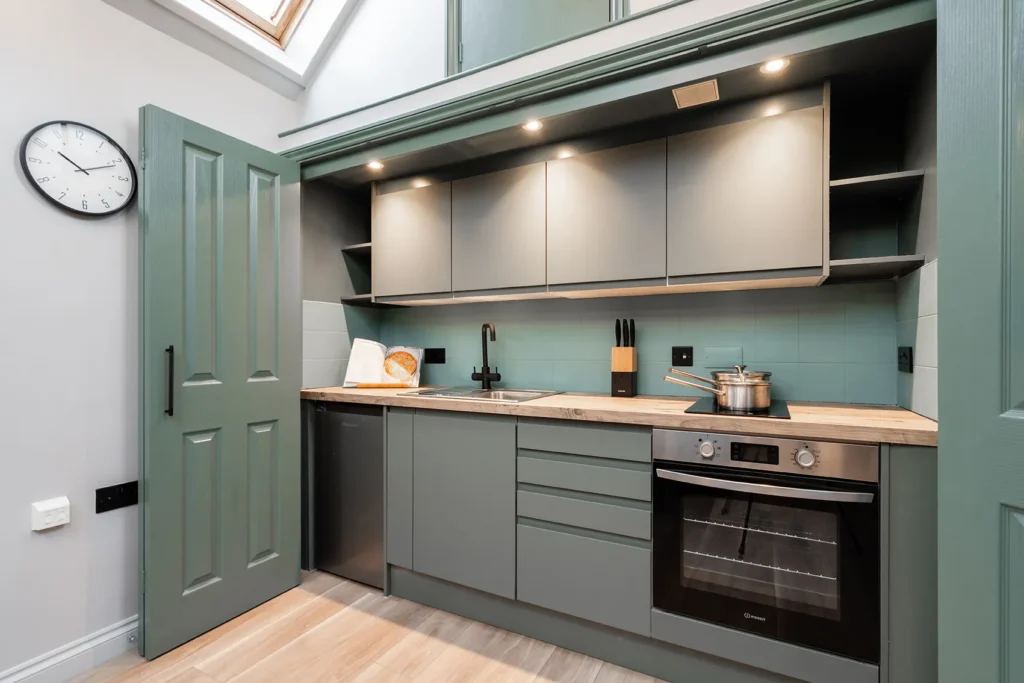
In co-living en-suite rooms, the rent covers every bill, including council tax. In studios and one-bed flats, it covers all bills except council tax and the TV licence. So a studio or one-bed budget needs two extra lines that an en-suite budget doesn’t.
Council tax depends on the valuation band of the property and what the local council charges for that band, as the GOV.UK council tax guide explains. Ask for the band and the amount before the employee signs, and treat it as a monthly cost on top of the rent.
The TV licence matters only if the employee watches live TV or uses BBC iPlayer. If they do, the GOV.UK TV Licence page gives the cost as £180 a year at the time of writing. Streaming services alone don’t need one.
Parking is separate again. Co-living has free on-street parking in front of the houses on a first come, first served basis. Each studio and one-bed flat has an allocated space for £50 a month, so £600 over 12 months. A car-owning employee in a flat should have that line in the budget, and in a co-living room you should still ask what happens if the street is full.
Cleaning covers communal areas only, so the employee looks after their own room. Ask what the arrival setup includes.
How do short stays change the budget?
Short stays carry a premium on the monthly rent. It is highest for the shortest stays and eases as the stay gets longer, and over 6 months the advertised price applies. On B-Hive’s published short-stay terms, a 3-month assignment would cost more per month than the table shows, although B-Hive hasn’t said how the premium applies to company bookings.
So don’t build a number from the advertised rent alone. Ask for a quote for the actual start and end dates and put that figure into the budget, not an estimate. Keep the quote with the budget, because it is the evidence if a number is queried later.
The contract type changes the risk too. A periodic contract needs 2 months’ notice, so budget rent through the notice period when the assignment ends. B-Hive says a fixed term has no notice period but can’t be ended early, so the whole term is committed rent. If the assignment length is uncertain, a periodic contract fits better; if it is firm, a fixed term can match it. Ask us to set out the contract type and its terms in writing before you decide, and see our post on periodic versus fixed-term corporate housing for the comparison.
What should the quote say before you commit?
It should let finance see every line without a follow-up email. Ask for the items below in writing and keep them with the budget.
- The home type, the town and the exact start and end dates.
- Whether the contract is periodic or fixed term, and the notice that applies.
- The monthly rent for those dates, including any short-stay premium.
- What the rent covers for that home type, and what it doesn’t.
- Which deposit option applies and who pays it.
- Who is invoiced: your company, or each resident.
If any line is missing, treat the number as a starting point, not a budget.
How does the deposit affect cash flow?
B-Hive offers two options: a deposit of 5 weeks’ rent, protected and refundable through the DPS, or a Reposit fee, which is non-refundable and normally 1 week’s rent, subject to Reposit’s terms. One ties up more cash, and the other costs a fee you won’t get back.
For budgeting, treat the DPS deposit as money out and later back in, less any deductions, and the Reposit fee as a one-off cost. Decide who pays it: the company, the employee, or the company with the employee repaying. Ask B-Hive whether a company can pay the deposit.
Rent is by direct debit on the 1st of each month, with the first month pro rata. B-Hive also says it can invoice your company directly, or residents can pay individually, so you can choose whether the rent runs through the company’s accounts payable or the employee’s bank.
How is relocation money treated for tax?
That is a question for your payroll adviser or accountant, not for a housing provider. GOV.UK sets out the rules, and they shape how HR frames a relocation package.
GOV.UK’s guide to relocation costs says some relocation costs up to £8,000 are exempt from reporting and paying tax and National Insurance. It calls them qualifying costs and lists buying or selling a home, moving costs, buying certain things for a new home, and bridging loans. They qualify only in set circumstances, including a new employee moving area to start a job. Other relocation expenses are treated as non-qualifying and have different rules.
The guide doesn’t say which group temporary rent falls into, so don’t assume the £8,000 covers it. Ask your adviser before you promise the employee a tax treatment.
Frequently asked questions
Does the rent include Wi-Fi and utilities?
In co-living rooms, the rent covers every bill, council tax too, with fibre internet among them. Studios and one-bed flats cover all bills except council tax and the TV licence.
Is a 3-month stay priced at the advertised monthly rent?
No. The advertised price is for stays over 6 months, and short stays carry a premium on the monthly rent. Ask for a quote for your dates.
Is there an extra charge for a second person?
Couples can live in a Hive Plus en-suite room, a studio or a one-bed flat, and the price covers two people with no extra charge for the second person.
Can the company pay instead of the employee?
B-Hive says it can invoice your company directly, or residents can pay individually.
Is parking extra?
Co-living has free on-street parking in front of the houses, first come, first served. Each studio and one-bed flat has an allocated space for £50 a month.
For a quote based on real dates and headcount, send the number of people, the dates and your preferred town through the corporate enquiry form. If you are comparing home types first, the B-Hive homes page lists them.
Sources
- How Council Tax works: Working out your Council Tax - GOV.UK GOV.UK (Government Digital Service), checked October 2026
- TV Licence - GOV.UK GOV.UK (Department for Culture, checked October 2026
- Expenses and benefits: relocation costs: What you do not have to report - GOV.UK GOV.UK (Government Digital Service, checked October 2026